Not all of Berlin moves at the same pace. While the city average tells one story, the real picture is hyperlocal. Some districts are seeing price growth of nearly 10 percent. Others are flat or still adjusting. If you are thinking about where to put your money in 2026, understanding the dynamics of individual neighborhoods matters more than any headline number.
Treptow-Kopenick: The Fastest Growing District
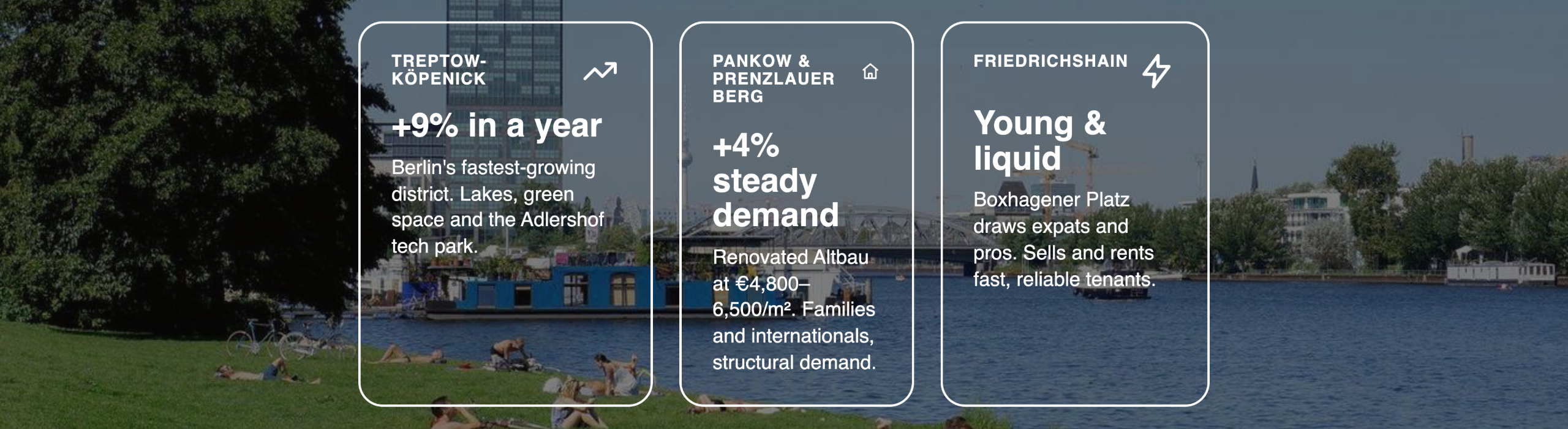
Treptow-Kopenick is the standout performer of 2025 and early 2026, with property prices rising around 9 percent over the past year. The area offers larger apartments, green spaces, and lakes that attract families priced out of inner-city districts. Adlershof, home to a growing tech and science park, is particularly interesting for investors seeking tenant stability. Entry prices are still meaningfully below central Berlin, which means the yield picture is more attractive
Pankow and Prenzlauer Berg: Consistent Demand
Pankow, including the western edge of Prenzlauer Berg and Weissensee, has recorded around 4 percent annual price growth. The neighborhood has long been one of the most popular for young families and international residents. Demand for two and three-bedroom apartments is structural here, driven by the absence of alternatives at a comparable quality level nearby. Renovated Altbau apartments in Prenzlauer Berg trade between 4,800 and 6,500 euros per square meter and rent quickly.
Friedrichshain: Young, Dense, and Liquid
Friedrichshain remains one of the most internationally popular neighborhoods in Berlin, consistently attracting young professionals and expats. The area around Boxhagener Platz and Revaler Strasse has seen sustained rental demand. Apartments here move fast, both for sale and for rent. For buy-to-let investors, the tenant base is reliable and turnover is manageable.
Charlottenburg-Wilmersdorf: The Traditional Premium Address
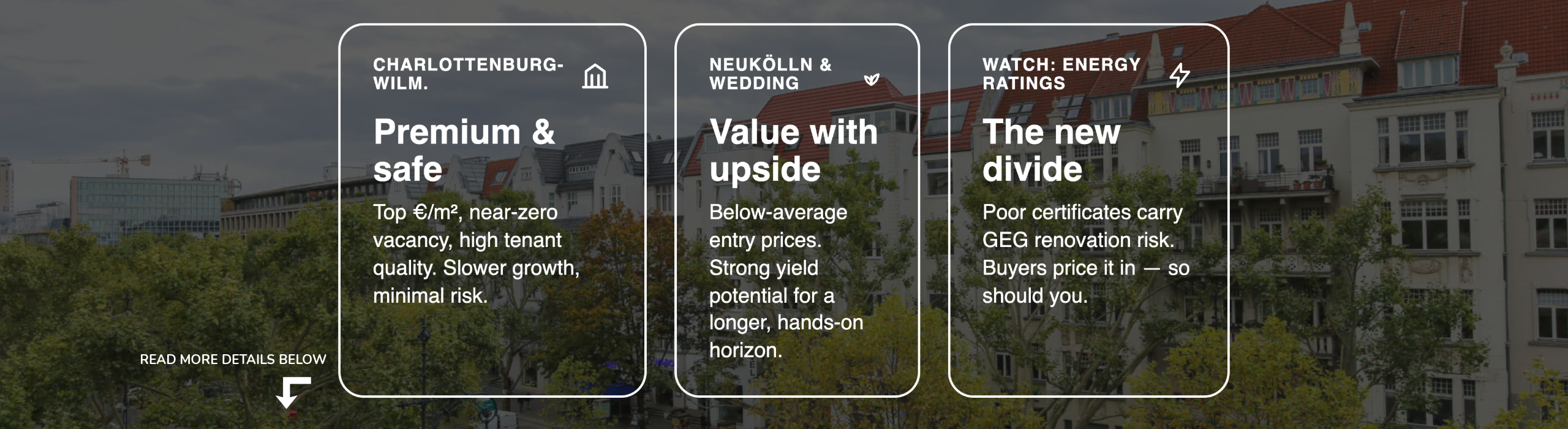
West Berlin’s established premium districts attract a different buyer profile: international buyers, families seeking good schools, and older residents who value quiet streets and well-maintained buildings. Charlottenburg commands some of the highest prices per square meter for existing apartments in Berlin. Capital growth may be slower here than in emerging eastern districts, but vacancy risk is essentially zero and tenant quality is consistently high.
Neukölln and Wedding: Value With Upside
Neukölln has been the subject of investor attention for years, and while it has matured considerably, entry prices remain below the city average. Wedding, further north, is at an earlier stage. Both neighborhoods attract younger tenants, artists, and newcomers to Berlin, with a strong international flavor. For investors with a longer horizon and tolerance for more active management, these areas offer yield potential that centrally located districts cannot match.
What to Watch For in Any District
Energy ratings are increasingly dividing properties into two camps across all neighborhoods. A well-located apartment with a poor energy certificate is no longer the straightforward bargain it might once have been. Renovation costs under Germany’s Building Energy Act can be substantial, and buyers are pricing this risk in. The best investments in 2026 combine good location with either a strong energy rating or a clear, budgeted renovation path.
Your Home Berlin manages rental properties across all Berlin districts.
Contact us at info@yourhomeberlin.com