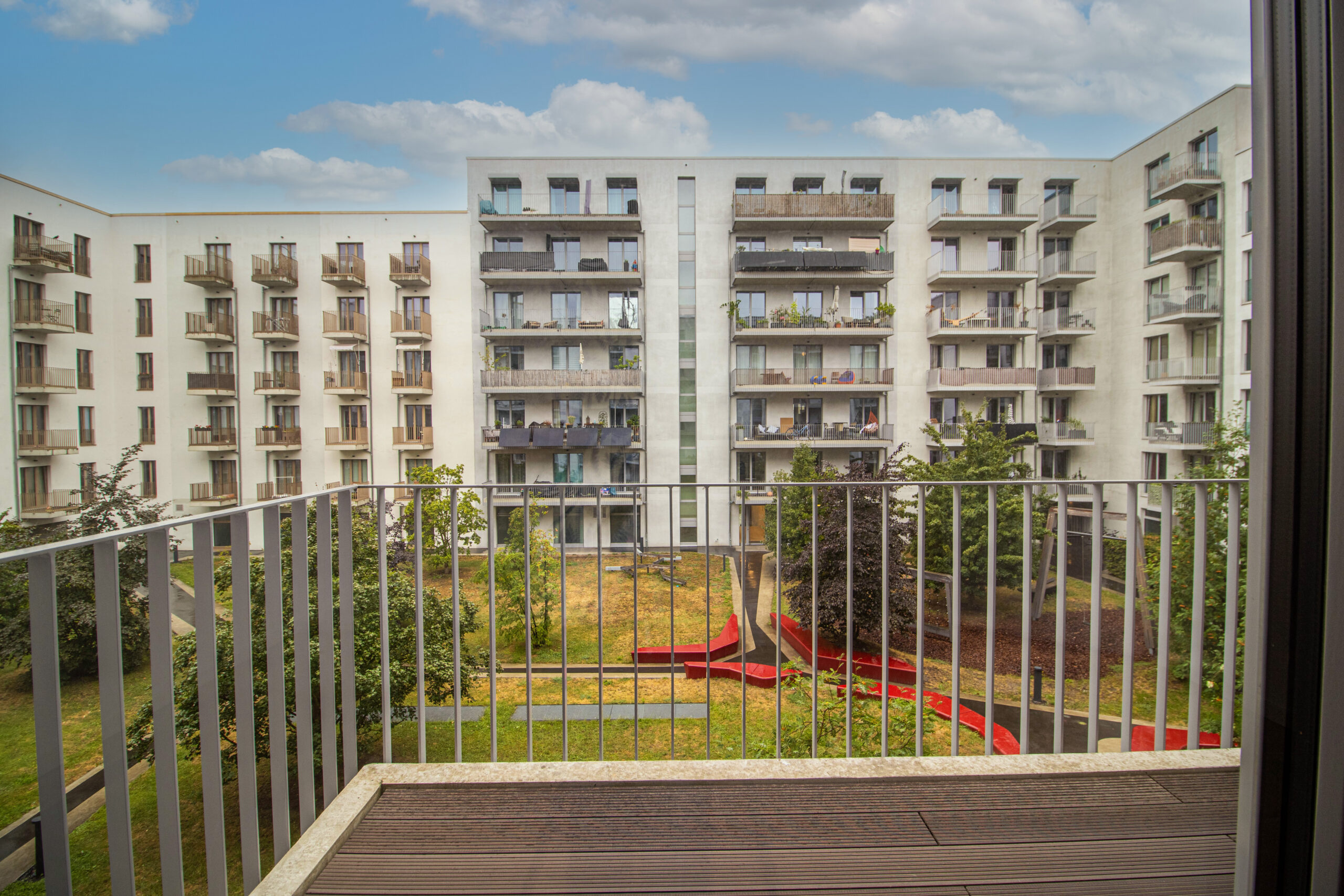
It is August, more than halfway through 2026, the Berlin property market has settled into a rhythm that would have been hard to imagine 18 months ago. The correction is over.
Prices Are Rising, Just Not Fast
Prices are rising, but slowly. Buyer confidence has returned without the exuberance of the pre-2022 years. And a series of policy and rate changes in the first half of the year have quietly reshaped what buyers, sellers, and landlords should be planning for over the second half. This is where the market stands as of July 2026, and what it is likely to do next.
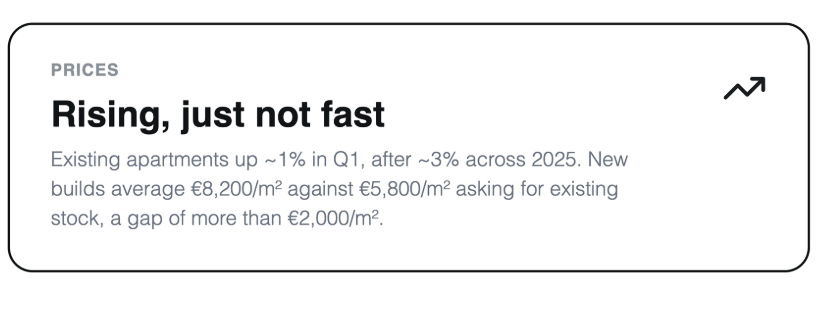
The headline number from the first quarter of 2026 is a modest one. Existing apartment transaction prices in Berlin rose by around 1 percent quarter on quarter, following the roughly 3 percent gain recorded across 2025. New-build apartment prices are averaging around 8,200 euros per square meter across the city. The average asking price for existing apartments sits close to 5,800 euros per square meter.
The gap between new-build and existing stock has widened to more than 2,000 euros per square meter. That gap tells you two things: construction remains expensive, and buyers are still finding better value in the resale market where they can inherit an established building and, in many cases, an existing energy rating they can plan around.
The ECB Surprise and What It Means for Mortgages.
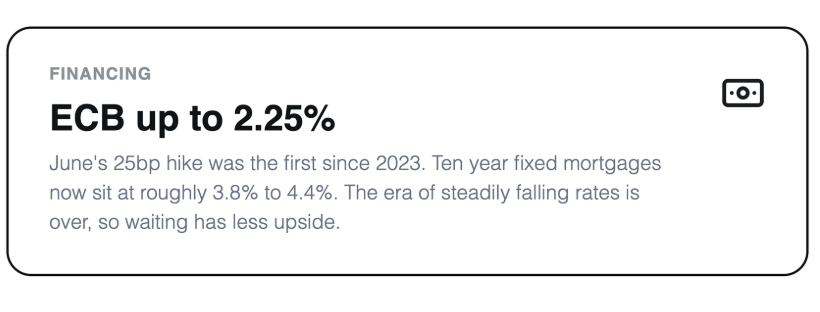
In June 2026, the European Central Bank raised its deposit facility rate by 25 basis points to 2.25 percent. This was the first ECB hike since 2023, and it caught a share of the market off guard. German mortgage lenders have adjusted accordingly, with 10-year fixed rates now sitting in a range of roughly 3.8 to 4.4 percent depending on the borrower profile and loan-to-value ratio.
This is not a shock. It is a reminder that the era of steadily falling rates is over for now, and that buyers who were waiting for further softening have less reason to keep waiting. The most active buyer conversations in H2 are from people who accepted the current rate environment as the new baseline rather than a temporary detour.
Where Demand Is Actually Concentrating
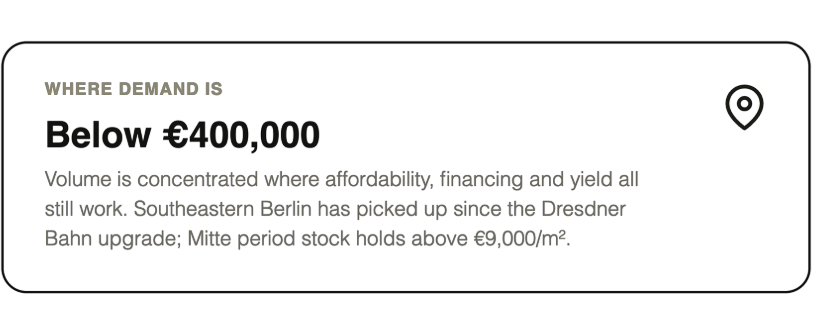
The strongest transaction activity in H1 2026 has been in properties priced below 400,000 euros. This is not the trophy segment. It is the segment where affordability, financing feasibility, and yield economics all still work. Central districts continue to attract international demand at higher price points, but the volume is happening below that threshold.
Geographically, southeastern Berlin has picked up meaningfully since the Dresdner Bahn rail improvement completed at the end of 2025. Airport connectivity and reduced commute times have translated into visible demand growth in Treptow-Köpenick and adjacent areas. Charlottenburg and Mitte remain the reference points at the top end, with Mitte transaction prices for period apartments hovering above 9,000 euros per square meter.
The Regulatory Weight of H2 2026
Two regulatory shifts are shaping H2. First, the Mietpreisbremse has been formally extended through 2029, closing off any lingering speculation about a softer rent regime. Second, the Building Modernisation Act, transposing the revised EU Energy Performance of Buildings Directive, is entering into force during the second half of the year. New energy certificates now use the A to G scale, and the trigger points for issuing a certificate have expanded.
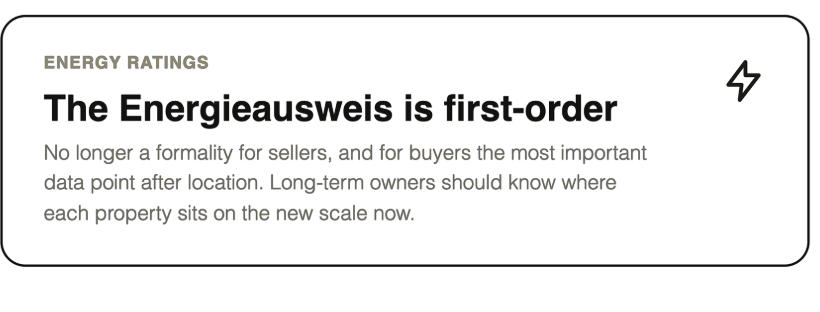
For sellers, this means the Energieausweis is now a first-order document rather than a formality. For buyers, it is the single most important data point after location. For long-term owners, this is the year to understand where each property sits on the new scale before the market prices in the difference more sharply than it already has.
What to Watch in H2
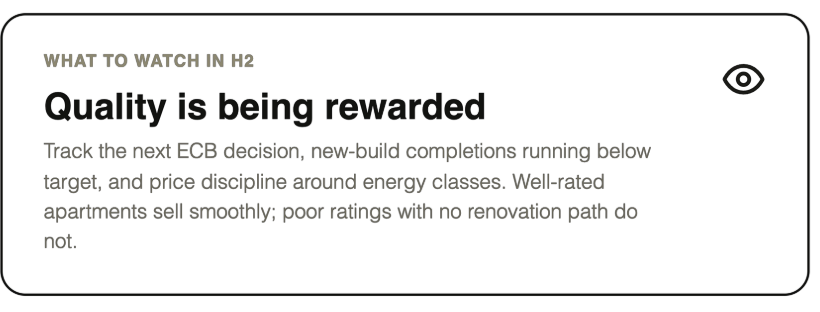
The three things worth tracking through the rest of 2026 are the direction of the next ECB decision, the pace of new-build completions, which are running well below the federal target, and the emerging price discipline around energy classes. Well-located, well-rated apartments will continue to sell smoothly. The soft edges of the market, older buildings with poor ratings and no clear renovation path, will find fewer buyers and slower transactions.
The three things worth tracking through the rest of 2026 are the direction of the next ECB decision, the pace of new-build completions, which are running well below the federal target, and the emerging price discipline around energy classes. Well-located, well-rated apartments will continue to sell smoothly. The soft edges of the market, older buildings with poor ratings and no clear renovation path, will find fewer buyers and slower transactions.
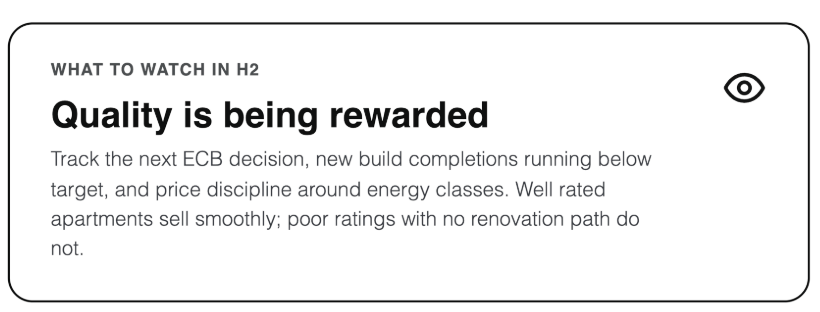
For international owners, the mid-year picture is a good one. The market is functional, liquid at the right price points, and structurally supported by chronic supply constraints. What has changed is the sharpness of the sorting: quality is being rewarded, and inertia is not.
Your Home Berlin advises international owners across the buy, hold, and sell cycle in Berlin.
Reach us at info@yourhomeberlin.com
YourHome Berlin provides a comprehensive platform for buying, selling, renting, and managing properties in Berlin.