No hype, no doom. Just an honest look at whether buying in Berlin makes sense right now.
People have been debating this question for the last two years. Prices dropped after the 2022 peak. Mortgage rates jumped. Transaction volumes fell. And a lot of buyers who were ready to move paused, waiting for clarity.
The case for buying
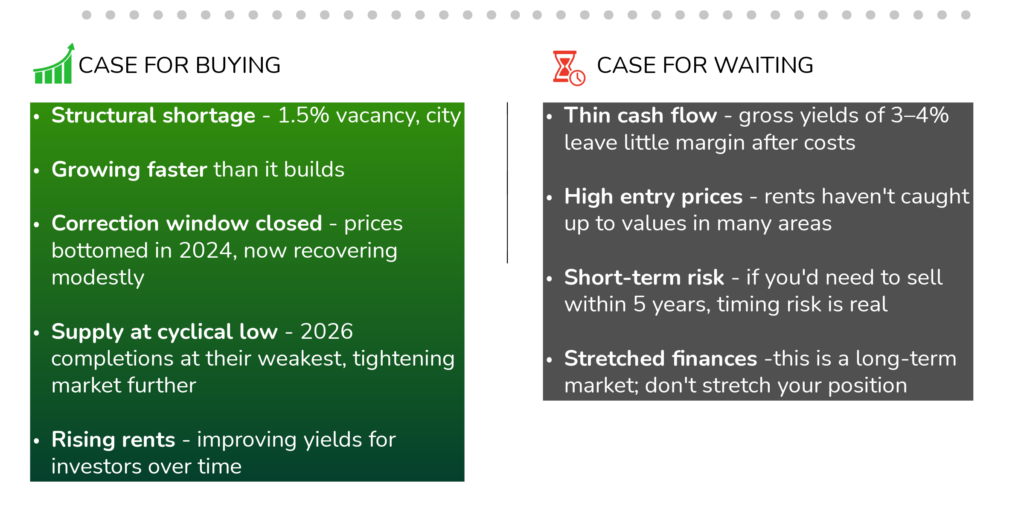
Berlin has a structural housing problem that is not going away. The vacancy rate sits at around 1.5%, one of the lowest in Europe. The city adds residents faster than it builds homes. New completions in 2026 are expected to be at a cyclical low, which only tightens supply further.
Prices have corrected from their 2022 peak by about 4% and are now recovering modestly. If you were waiting for a bigger correction, it appears that window has closed. The market bottomed in 2024.
Mortgage rates at 3.5% to 4% are manageable for buyers with a solid down payment and stable income. Not as cheap as 2020, but not the crisis level of 2023 either. And rents are rising, which means rental yields are improving for investors.
The case for waiting
If you are buying primarily as an investment and need immediate positive cash flow, Berlin is not easy right now. Entry prices are still high relative to current rents in many areas, meaning gross yields often sit between 3% and 4%. After costs, net yields can be thin in the short term.
If your financial situation is stretched, or if you would need to sell within five years, the timing risk is real. Berlin is a long-term market. Short-term gains are no longer guaranteed.

The honest bottom line
For owner-occupiers: if you find the right apartment at the right price and plan to stay for at least seven to ten years, buying in Berlin in 2026 makes sense. The structural case for the city is strong.
For investors: buying to rent in Berlin can still work, especially in emerging neighbourhoods like Treptow-Kopenick or Reinickendorf where yields are more attractive. One thing worth knowing: new-build apartments completed from 2014 onwards are exempt from the Mietpreisbremse. That means as a landlord you can set rents freely at market rates, without being bound by the local Mietspiegel cap. For investors focused on rental yield, this is a meaningful advantage over older stock. But do the math carefully before committing, because new-build purchase prices are significantly higher.
For everyone: do not buy based on fear of missing out, and do not wait for conditions that may never come back. Make the decision based on your actual numbers and your actual life.

Frequently asked questions
Is Berlin real estate a good investment in 2026?
For patient long-term investors, yes. Strong structural demand, rising rents, and a recovering price environment support the case. Short-term cash flow can be tight at current prices.
Have Berlin property prices bottomed out?
Most data suggests yes. Prices rose about 3% in 2025 and are continuing to climb modestly in 2026. The correction phase appears to be over.
What is the average price per square meter in Berlin in 2026?
Transaction prices average around 5,130 euros per square meter. Asking prices are closer to 5,700 to 5,800 euros per square meter. Central premium locations like Mitte and Prenzlauer Berg are significantly higher.
Berlin is not a get-rich-quick market. It never really was. But for people who understand it, plan for the long term, and buy smartly, it remains one of the most solid property markets in Europe.
Thinking about buying in Berlin and want a straight answer on whether it makes sense for your situation? Your Home Berlin is happy to talk it through with you.