Rental income in Germany is taxed at your progressive personal income tax rate, and for owners in central Berlin with a good rental yield, that can mean a marginal rate of 42 percent or more. What many international landlords miss is that German tax law is unusually generous with deductions for real estate. Between depreciation, financing costs, and operating expenses, a well-structured Berlin rental can generate meaningful taxable losses in the early years even while producing positive cash flow.
Here are seven techniques that make the biggest difference:
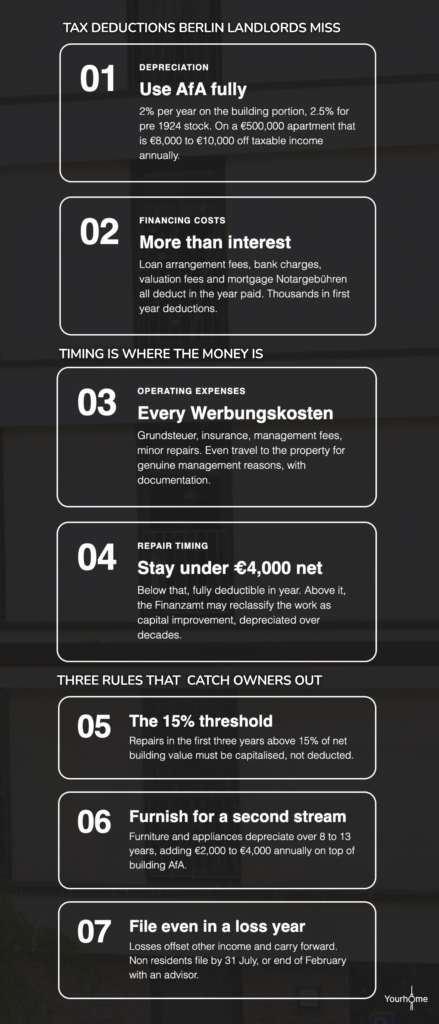
1: Use Depreciation Fully
The Absetzung für Abnutzung, or AfA, allows you to depreciate the building portion of your property at 2 percent per year for buildings completed after 1924, and at 2.5 percent per year for older buildings. On a 500,000 euro apartment where the building value is around 400,000 euros, that is 8,000 to 10,000 euros deducted from taxable income every year. This is the single largest routine deduction most Berlin landlords receive, and yet many first-time landlords apply it incorrectly or not at all.
2: Deduct All Financing Costs, Not Just Interest
Mortgage interest is fully deductible. Principal repayments are not. But there is more than just interest. Loan arrangement fees, bank charges related to the mortgage, valuation fees paid to secure the loan, and Notargebühren associated with the mortgage registration are all deductible in the year they are paid. For newly acquired properties, this can add several thousand euros of first-year deductions that many owners overlook.
3: Capture Every Operating Expense
The Werbungskosten category covers a wide range of ongoing expenses. Grundsteuer paid by the owner, building insurance, property management fees, non-recoverable Hausgeld portions, minor repairs, professional cleaning of common areas, and travel to the property for management purposes are all deductible. Owners who visit their Berlin property once or twice a year for legitimate management reasons can deduct the flight and accommodation costs against rental income, within reasonable limits and with documentation
4: Time Larger Repairs Strategically
Repairs under 4,000 euros net can generally be deducted fully in the year they are incurred. Larger works risk being reclassified by the Finanzamt as capital improvements, which then need to be depreciated over decades rather than deducted immediately. If you have multiple repair projects planned, splitting them across tax years or keeping individual invoices below the 4,000 euro threshold where genuinely possible can materially accelerate the tax benefit.
5: Handle the First Three Years Carefully
There is a specific German rule, anschaffungsnaher Aufwand, that captures repairs performed within the first three years after acquisition. If those repairs exceed 15 percent of the building value net of VAT, they must be treated as capital investment and depreciated over the building’s useful life rather than deducted in the year of the work. For a newly acquired Berlin apartment that needs work, planning the renovation timing around this threshold, either compressing within a single tax year or spreading beyond the three-year window, has significant tax consequences.
6: Consider Furnished Letting for the Furniture Depreciation
Furnished apartments generate an additional deduction stream. Furniture, appliances, and fittings can be depreciated over their useful lives, typically 8 to 13 years for furniture and shorter for electronics. For a fully furnished apartment, this can add 2,000 to 4,000 euros of annual depreciation on top of the building AfA. The rental income is higher too, but the tax structure is more favorable per euro earned.
7: File Every Year, Even When You Have a Loss
Rental losses in the early years of ownership can offset your other German-source income, and in some cases, income from your country of residence through the applicable double taxation agreement. Losses can also be carried forward against future rental profits. Owners who skip filing because they had a loss year often forfeit these benefits entirely.
For non-resident landlords, the filing deadline is 31 July of the following year, or the end of February in the second following year with a tax advisor. Missing deadlines creates penalties that far exceed the cost of preparation. This is one area where working with a qualified German tax advisor is not optional.
Your Home Berlin connects international owners with vetted German tax advisors and prepares clean cost documentation. Email info@yourhomeberlin.com